A guide to choosing the best Interior Design Master's programs in the USA.
If you're researching the best Master's in Interior Design programs in the United States, you've probably already come across names like Pratt Institute, Parsons School of Design, New York School of Interior Design (NYSID), Rhode Island School of Design (RISD), and Savannah College of Art and Design (SCAD).
But here's something I encourage students to think about before building their university list: the most prestigious school is not necessarily the right school for you.
An applicant with a Bachelor's degree in Interior Design, a student with a five-year architecture degree, and someone transitioning from business or fine arts may all be interested in interior design graduate school. Yet they may need completely different programs, portfolios, and application strategies.
Some Master's programs focus on professional interior design practice. Others emphasize experimental design, research, adaptive reuse, sustainability, or the relationship between people and their environments. Some accept students without previous design education, while others expect a substantial design background.
I've studied architecture at the University of Michigan and design at Harvard Graduate School of Design, and my career has since taken me across architecture, technology, and entrepreneurship. One of the most important lessons I've learned is that choosing a graduate program should begin with understanding the kind of designer you want to become.
In this guide, we'll look at some of the leading Interior Design Master's programs in the USA, how they differ, what their applications involve, and how to build a university shortlist that fits your goals.

Explore leading U.S. Interior Design Master's programs and find the right fit for your goals.
Quick Comparison: Top Interior Design Master's Programs in the USA
These are not ranked from first to last. They represent different approaches to graduate education in interior design and related interior architecture fields.
Pratt Institute, MFA Interior Design, focuses on advanced interior design, spatial research, and professional practice. It is particularly worth exploring if you want a studio-intensive education with design experimentation.
Parsons School of Design, MFA Interior Design, focuses on experimental interiors, research, and social and environmental questions. It is particularly worth exploring if you want an interdisciplinary, concept-driven approach.
New York School of Interior Design, MFA Interior Design, focuses on interior design education and advanced professional study. It is particularly worth exploring if you want a specialized institution focused on interiors.
Rhode Island School of Design, MDes Interior Studies, focuses on adaptive reuse, interior architecture, and exhibition environments. It is particularly worth exploring if you want to explore the transformation of existing buildings and spaces.
Savannah College of Art and Design, MFA Interior Design, focuses on interior design studios, environmental psychology, and research. It is particularly worth exploring if you want a structured graduate curriculum combining research and practice.
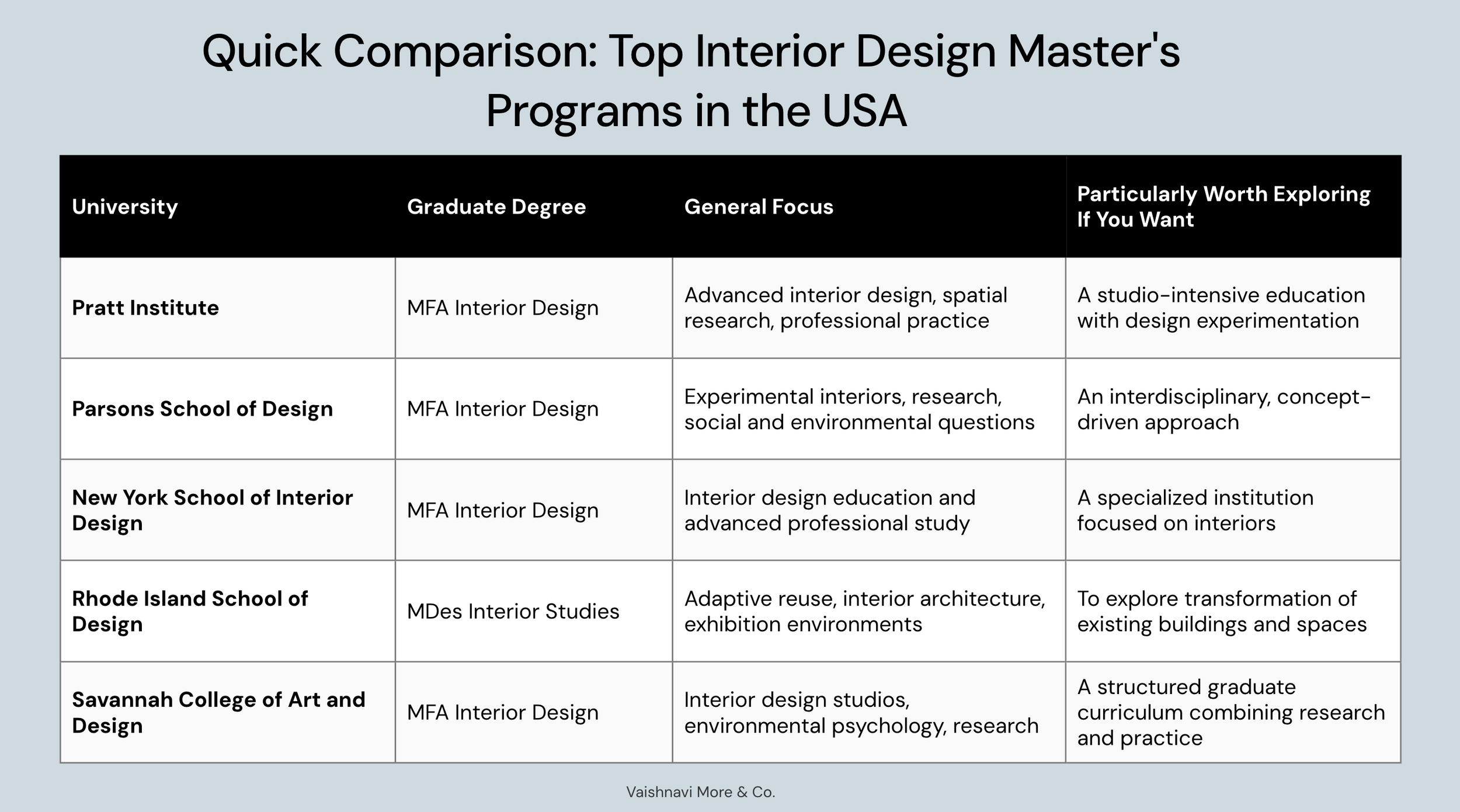
Compare Pratt, Parsons, NYSID, RISD, and SCAD by degree type, academic focus, and design interests.
The programs above are different in degree structure, academic emphasis, and admission expectations. That is precisely why comparing them only through rankings can be misleading.
1) Pratt Institute — Master of Fine Arts in Interior Design
Location: Brooklyn, New York
Degree: MFA Interior Design
Duration: Two years for eligible applicants with relevant design education; three years including a Core Year for applicants from other disciplines.
Explore Pratt's official Interior Design MFA program
Pratt is one of the most recognizable names in American art and design education. Its Interior Design MFA is particularly interesting because it combines rigorous studio work with research, experimentation, and an expanded understanding of the spaces people inhabit.
Pratt offers two pathways into its MFA program.
Applicants who already have an undergraduate degree in interior design, architecture, or a closely related field may qualify for the 60-credit, two-year program. Students whose previous education is unrelated to design enter through a 24-credit Core Year before beginning the 60-credit MFA curriculum. That distinction is important because it means Pratt can be relevant to both trained designers and students transitioning into interior design.
What does Pratt look for in a portfolio?
For applicants to the two-year MFA, Pratt requires a portfolio containing academic or professional work relevant to their background. The university recommends including research and design process rather than only finished renderings. Physical models, hand drawings, and evidence of design development can all contribute to a stronger submission.
Applicants should also identify their specific contributions to collaborative work. This is an important lesson for graduate applicants: a portfolio containing beautiful final images may still be missing the information an admissions committee needs to evaluate your thinking.
Who should consider Pratt?
I would encourage students to investigate Pratt if they are interested in developing a more advanced design practice, exploring spatial ideas through studio work, and working within New York's broader design environment. However, before applying, examine the curriculum and recent student work. Your portfolio should communicate why this particular academic environment fits your interests.
Application advice: If Pratt is on your shortlist, first confirm which MFA pathway applies to your undergraduate background. Then evaluate whether your portfolio demonstrates both design process and final outcomes.

The right university isn't always the most prestigious one. It's the one that fits the designer you want to become.
2) Parsons School of Design — MFA Interior Design
Location: New York City
Degree: MFA Interior Design
General focus: Experimental, research-driven, socially engaged interior design.
Explore Parsons' official MFA Interior Design program
Parsons approaches interior design as a discipline connected to much larger questions about how people live, work, interact, and experience space. Its MFA program emphasizes research and explores interiors through social practice, technology, materials, ecology, health, and changing relationships between people and their environments.
This makes Parsons particularly interesting for students who want to explore interior design beyond conventional residential or commercial project briefs. For example, you may be interested in how interior spaces respond to climate change, how materials influence human experience, or how designers can rethink spaces for communities with different needs. These are the kinds of questions that can form the basis of meaningful graduate-level design investigations.
What should your Parsons portfolio demonstrate?
Parsons evaluates graduate portfolios for both technical and conceptual ability. That combination is important. Technical ability might be demonstrated through drawings, models, digital tools, fabrication, or sophisticated visual representation. Conceptual ability is more difficult to communicate.
It involves showing why you made particular decisions, what questions motivated your work, and how you developed your ideas. Your portfolio should not simply demonstrate that you know how to use design software. It should help reviewers understand how you approach a design problem. Parsons also expects graduate portfolios to be tailored to the specific program.
Who should consider Parsons?
Parsons is worth researching if you are interested in interdisciplinary work, design research, social and environmental issues, or challenging conventional ideas about interior spaces.
Application advice: Research the program's recent student work and faculty interests. Then identify which projects in your own portfolio genuinely connect with your intended graduate direction.
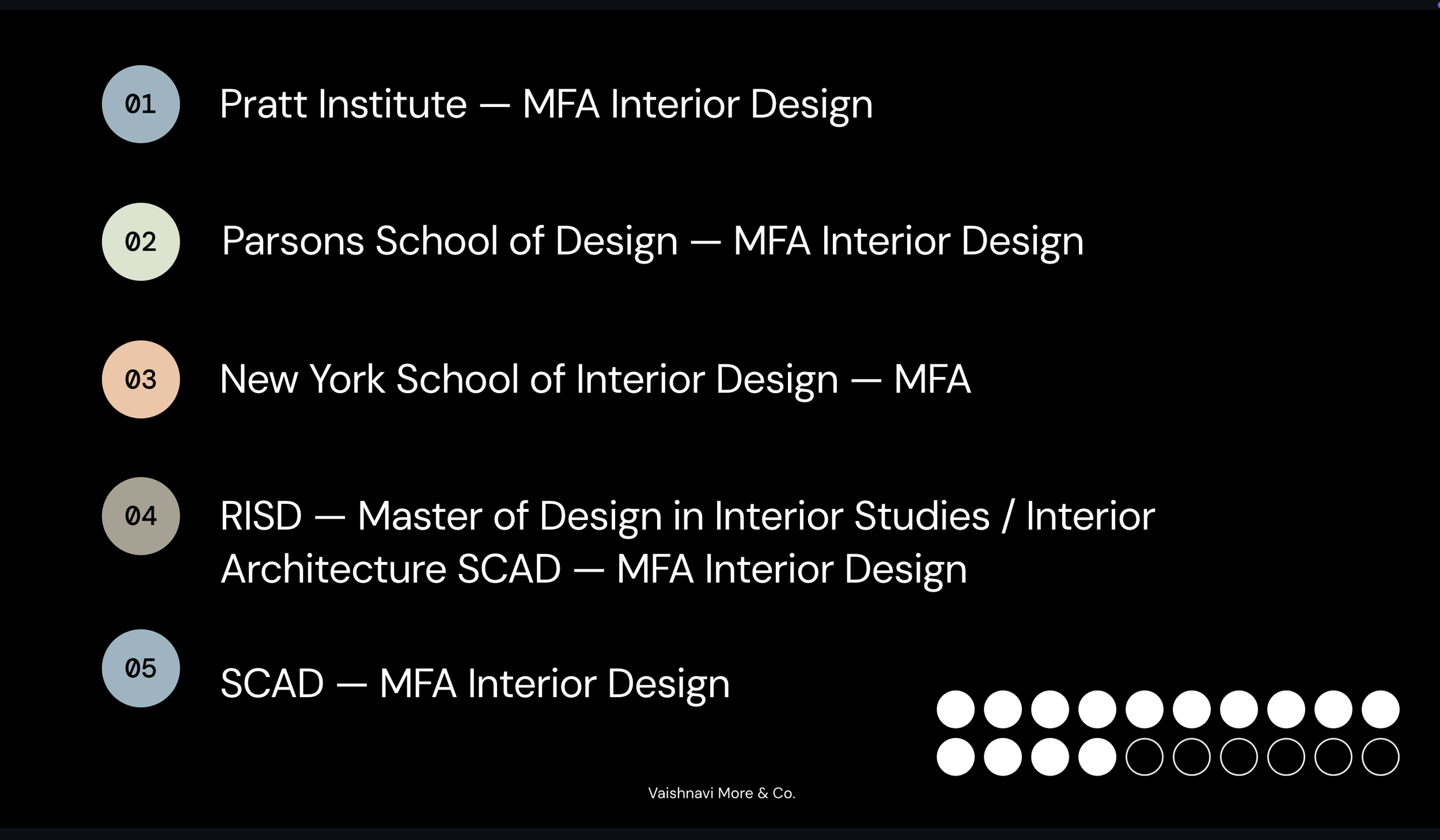
Five U.S. universities to explore for graduate study in Interior Design and Interior Architecture.
3) New York School of Interior Design — MFA Interior Design
Location: New York City
Degrees: MFA-1 and post-professional graduate pathways.
Explore New York School of Interior Design
NYSID is distinctive because the institution is specifically focused on interior design. For students who want a graduate education centered on interiors rather than a broader multidisciplinary art or architecture school, that specialization can be appealing. However, students need to understand the difference between NYSID's graduate pathways before preparing their portfolios.
MFA-1: For students entering interior design
NYSID's MFA-1 pathway is intended for students seeking graduate-level professional interior design education. Its portfolio requirements are notably different from those of many other design schools. According to NYSID's published admissions guidance, MFA-1 applicants submit 10–15 examples of fine-art work. The school emphasizes work created by hand and from life, including drawing, painting, and sculpture.
That is very different from a conventional architecture portfolio containing only floor plans, digital renders, and completed studio projects. The university wants to evaluate foundational visual abilities, including observation, proportion, and perspective.
MFA-2: For applicants with prior interior design education
The post-professional MFA-2 pathway is intended for applicants with an appropriate previous design background. Here, the portfolio expectations are more advanced and oriented toward professional-level interior design work. This is why I strongly discourage students from assuming they can submit the same portfolio to Pratt, Parsons, and NYSID without substantial review. The institutions may be looking for different evidence of your abilities.
Who should consider NYSID?
NYSID is worth exploring if you want to study at an institution with a concentrated focus on interior design and develop your education within a specialized design environment.
Application advice: Confirm whether MFA-1 or MFA-2 is appropriate for your academic background before selecting any portfolio work.
Official NYSID admissions information
4) Rhode Island School of Design — Master of Design in Interior Studies
Location: Providence, Rhode Island
Degree: Master of Design (MDes)
Focus: Interior architecture, adaptive reuse, exhibition and narrative environments.
Explore RISD's Interior Architecture graduate programs
RISD offers a particularly interesting alternative for students whose interests sit between architecture and interior design. Rather than focusing exclusively on creating new interiors, its graduate Interior Architecture programs explore how existing structures can be transformed through thoughtful design interventions.
One pathway emphasizes adaptive reuse. Another focuses on exhibition and narrative environments. These areas can lead students toward very different kinds of work.
Why adaptive reuse matters
Consider an old industrial building that is no longer serving its original purpose. An adaptive reuse project might explore how the building could become housing, a cultural center, a workplace, or a community facility. The designer must consider the existing structure, history, materials, spatial qualities, and new human needs. This creates an opportunity to work across architectural thinking, interior interventions, environmental responsibility, and design research.
What kind of applicant might enjoy RISD?
I would encourage students to investigate RISD if they are interested in existing buildings, sustainability, heritage, spatial transformation, exhibitions, or experimental approaches to interiors. A student who enjoys working with architectural sections, physical models, existing structures, and spatial interventions may find these programs particularly compelling.
Application advice: Do not assume that an MDes in Interior Studies is identical to an MFA in Interior Design. Compare the curriculum, career pathways, and professional qualification implications before applying.
5. Savannah College of Art and Design — MFA Interior Design
Locations: Savannah and Atlanta, Georgia
Degree: MFA Interior Design
Focus: Advanced interior design studios, research, environmental psychology, inclusive design, and thesis development.
Explore SCAD's MFA Interior Design program
SCAD offers a structured graduate curriculum that combines interior design studios with theoretical and research-based study. Its published 2026–2027 MFA curriculum includes environmental psychology, research methods, interior design theory, inclusive design, contemporary issues, and thesis studios. These subjects reflect the fact that interior design involves much more than selecting furniture, finishes, or materials.
Interior designers need to understand how people use environments, how different populations experience space, and how design decisions affect functionality and well-being.
Who should consider SCAD?
SCAD is worth researching if you want a graduate curriculum with substantial studio work, structured coursework, and opportunities to investigate professional interior design problems. Students interested in hospitality, workplace, residential, public, or inclusive environments may find relevant areas of study within the program.
Application advice: Compare SCAD's MFA with its MA in Interior Design. They are different degrees with different curricular structures. Do not choose one based solely on duration.
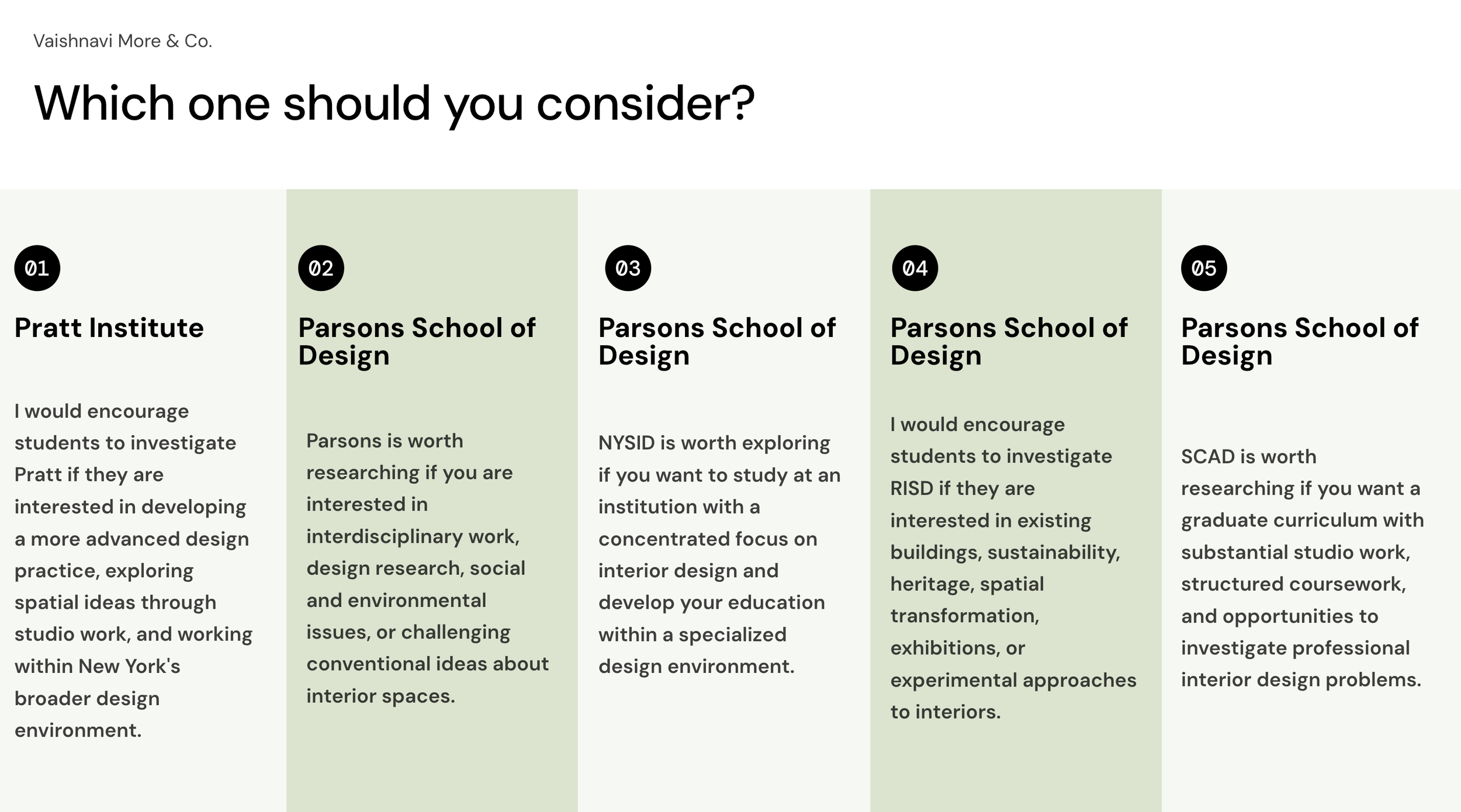
Each university offers a different approach to Interior Design. Choose based on your interests and career direction.
How to Choose the Right Interior Design Master's Program
Now that you have an initial list of universities, the more important question is how to decide which programs deserve a place on your application shortlist.
I recommend evaluating each program across five areas.
1. Your previous education
Start with your undergraduate degree. If you already have a Bachelor's in Interior Design or Architecture, you may qualify for graduate pathways that assume prior design training. If your undergraduate degree is unrelated, you may need a program that offers foundational preparation. Do not assume that every MFA accepts the same academic background.
2. Your career direction
Ask yourself what you actually want to do after graduation. Are you interested in residential interiors, hospitality, workplace design, exhibitions, adaptive reuse, design research, sustainability, or interdisciplinary practice? These interests can lead you toward different degrees. A student interested in transforming historic buildings may find RISD's adaptive reuse focus more relevant than a student primarily interested in advanced interior design practice. Neither choice is universally better.
3. Your portfolio and design interests
Your existing work should influence your university selection. Look at the projects you have completed and identify your strongest areas. Do you excel at spatial planning? Material experimentation? Conceptual thinking? Technical drawings? Research? Visual storytelling? Then compare those strengths with the work and portfolio requirements of your target programs. You should be willing to improve and adapt your portfolio, but you should not have to invent an entirely different design identity for every school.
4. Financial and geographic fit
A graduate degree is a substantial financial commitment. Compare tuition, estimated living expenses, scholarships, program duration, and the financial implications of studying in each city. New York City, Providence, Savannah, and Atlanta offer different living environments and cost structures. Always use the university's official cost-of-attendance information rather than relying on outdated tuition figures from third-party websites.
5. Your long-term professional goals
If professional interior design certification or registration matters to you, investigate the relevant education and work-experience requirements. For example, NCIDQ eligibility depends on qualifying education and professional experience, and individual jurisdictions may have additional requirements. A Master's degree alone should not be assumed to guarantee professional certification.
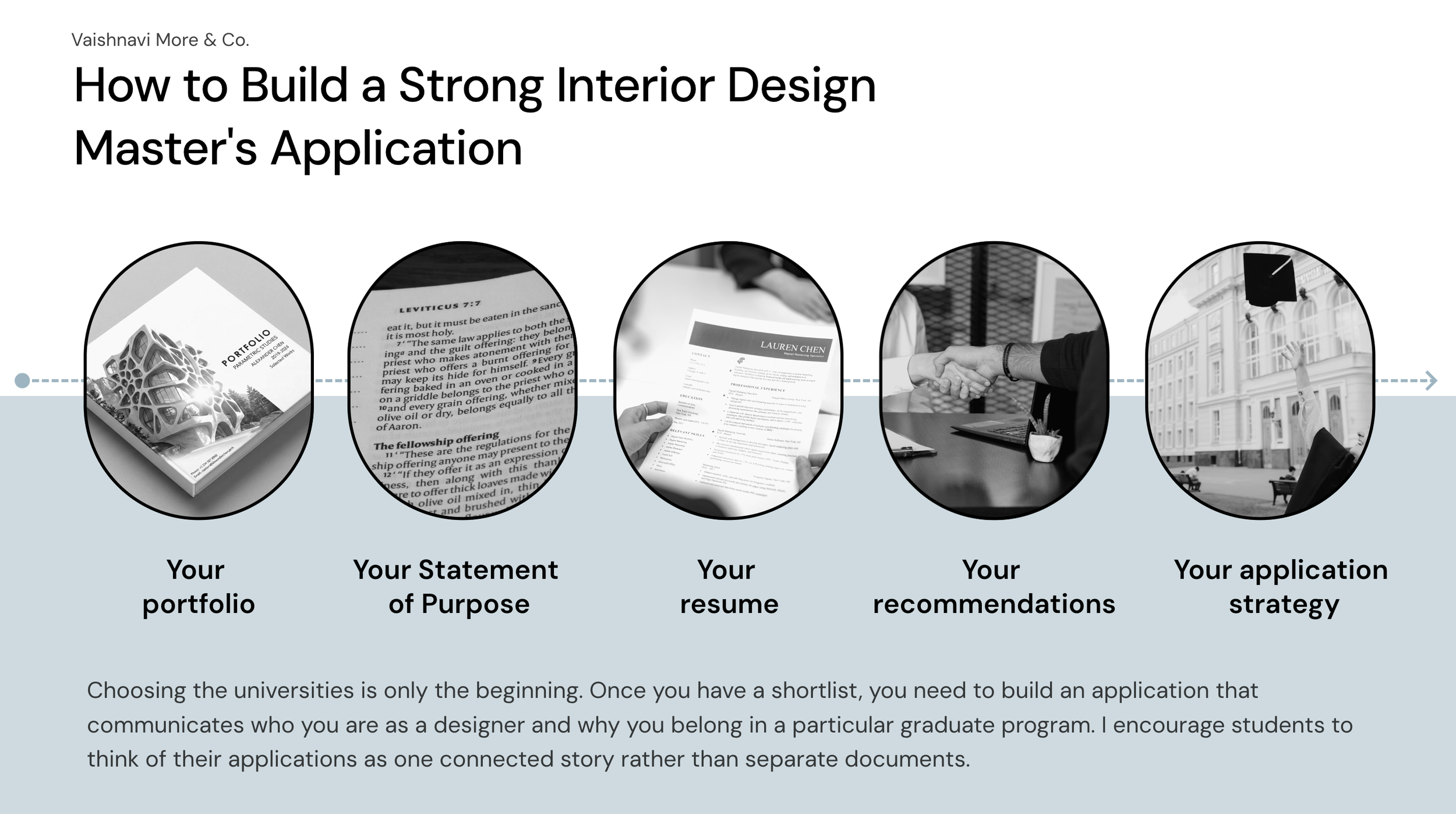
How to Build a Strong Interior Design Master's Application
Choosing the universities is only the beginning. Once you have a shortlist, you need to build an application that communicates who you are as a designer and why you belong in a particular graduate program. I encourage students to think of their applications as one connected story rather than separate documents.
Your portfolio
Your portfolio should demonstrate design thinking, spatial understanding, and the ability to communicate ideas.
Depending on the university, it may include academic projects, professional work, research, sketches, models, technical drawings, material studies, and final visualizations. The goal is not to include every project you have ever completed. It is to select the work that best represents your abilities and potential.
Your Statement of Purpose
Your SOP should explain why you want to pursue graduate study, what you have learned from your previous education and experiences, and why the specific university fits your goals.
Avoid writing the same generic statement for every program. A strong SOP should demonstrate that you understand what you are applying to and how it connects with your future direction.
Your résumé
Your résumé should communicate your education, design experience, relevant skills, projects, achievements, and other experiences that strengthen your candidacy.
For graduate admissions, relevance and clarity are more important than filling the page with every activity you have completed.
Your recommendations
Choose recommenders who can speak meaningfully about your abilities, work, academic potential, and character.
A thoughtful recommendation from someone who knows your work well may be more useful than a generic recommendation from someone with an impressive title.
Your application strategy
This is where many applicants underestimate the work involved.
Each university may have different portfolio formats, written requirements, submission systems, deadlines, and supporting documents. Create one master application tracker before you begin. Then work backward from the earliest deadline.
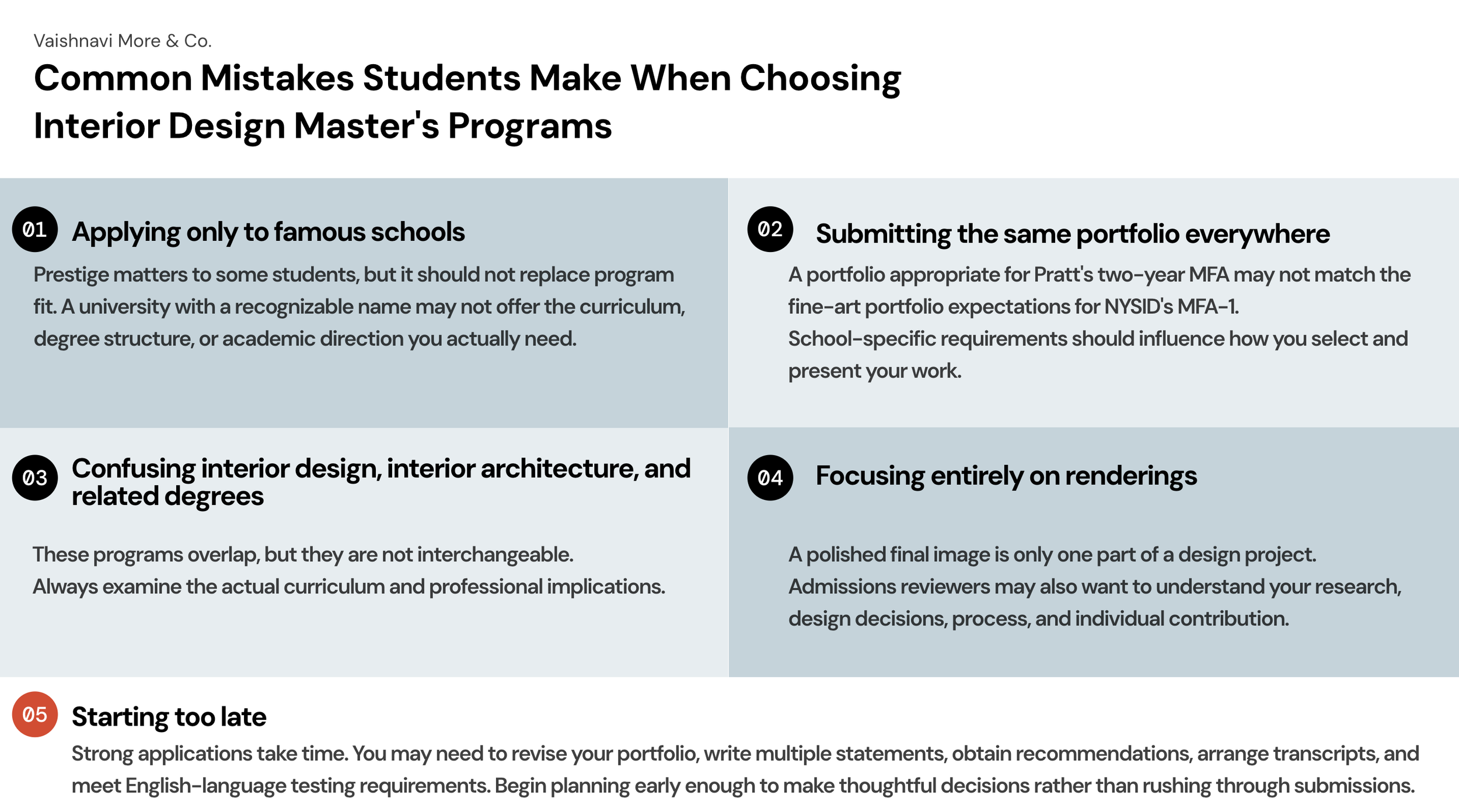
Common Mistakes Students Make When Choosing Interior Design Master's Programs
Applying only to famous schools
Prestige matters to some students, but it should not replace program fit.
A university with a recognizable name may not offer the curriculum, degree structure, or academic direction you actually need.
Submitting the same portfolio everywhere
A portfolio appropriate for Pratt's two-year MFA may not match the fine-art portfolio expectations for NYSID's MFA-1.
School-specific requirements should influence how you select and present your work.
Confusing interior design, interior architecture, and related degrees
These programs overlap, but they are not interchangeable.
Always examine the actual curriculum and professional implications.
Focusing entirely on renderings
A polished final image is only one part of a design project.
Admissions reviewers may also want to understand your research, design decisions, process, and individual contribution.
Starting too late
Strong applications take time.
You may need to revise your portfolio, write multiple statements, obtain recommendations, arrange transcripts, and meet English-language testing requirements.
Begin planning early enough to make thoughtful decisions rather than rushing through submissions.
Frequently Asked Questions
1) Which university is best for a Master's in Interior Design in the USA?
Pratt, Parsons, NYSID, RISD, and SCAD are all worth considering, but they offer different academic experiences. The best choice depends on your educational background, design interests, portfolio, career goals, and budget.
2) Is Pratt or Parsons better for interior design?
Neither is universally better. Pratt offers a studio-intensive MFA with pathways for applicants from different educational backgrounds. Parsons emphasizes experimental, research-driven, and socially engaged approaches to interiors. Compare their curricula and student work before deciding.
3) Can I pursue a Master's in Interior Design without a Bachelor's in Interior Design?
Yes, some programs accept applicants from unrelated academic backgrounds. Pratt, for example, offers a Core Year pathway for students who need foundational preparation. Eligibility varies by university.
4) Do I need a portfolio for an Interior Design Master's?
Many graduate interior design programs require a portfolio, but the content varies. Some emphasize design projects and process work, while others may ask for observational drawing or other creative work. Always check the specific program requirements.
5) Can architecture graduates apply for Interior Design Master's programs?
Yes. Architecture graduates may be eligible for several interior design graduate pathways. However, the appropriate degree depends on their previous qualification and the university's requirements.
6) Is an MFA in Interior Design better than an MA?
An MFA and an MA may differ in curriculum, depth, duration, and intended outcomes. Neither is automatically better. Compare what you will study and how the degree supports your career plans.
7) Can an international student apply for Interior Design Master's programs in the USA?
Yes, international students can apply to U.S. graduate interior design programs, subject to each university's admission and international applicant requirements. Students should verify academic eligibility, English-language requirements, financial documentation, and visa-related procedures directly with the institution.

Need Help Choosing the Right Architecture Master's Program?
If you're considering graduate school in the United States but are unsure which universities or degrees make sense for your background, you don't necessarily need to apply to more schools.
You may need a clearer strategy. I'm Vaishnavi More, an architect, graduate of the University of Michigan and Harvard Graduate School of Design, and founder of Vaishnavi More & Co. My journey has taken me through architectural education, advanced design study, technology, and entrepreneurship. I've experienced firsthand how graduate education can influence the direction of a career—and how important it is to make that decision thoughtfully.
Today, I work with students applying to Master's programs in Architecture, Interior Design, Urban Design, Landscape Architecture, and related design fields in the United States.
How I Can Help
Find the Right Master's Program: If you're still comparing universities and degrees, we can evaluate your education, experience, interests, career goals, and current shortlist in a 1:1 strategy session.
Architecture & Design Portfolio Review: If you already have a portfolio, I can help you identify which projects are strongest, what needs improvement, and how to communicate your design thinking more effectively.
Master's Application Strategy: If you've selected your universities but need help positioning your profile, we can work on a clearer application plan across your portfolio, SOP, and school-specific requirements.
Complete Master's Application Support: If you want guidance throughout the application process, I offer personalized support for developing a coherent, competitive application.
The goal is not simply to apply to the most recognizable universities. It's to make thoughtful choices about your education and present the strongest possible version of your work and potential.